From Distant to Deeply Connected: How a Simple App Brought My Dad and Me Closer
You know that moment when you call your parents, and you can hear the hesitation in their voice—like they don’t want to worry you, so they downplay everything? I did. I kept thinking, “I should check in more,” but life got busy. Work deadlines, school runs, grocery lists—it all piled up. Then we started using a simple health app together—not to track every heartbeat, but to share small daily wins. It became our bridge. Suddenly, we weren’t just talking at each other—we were living with each other, digitally. And honestly, it changed everything.
The Silent Distance Between Generations
Let’s talk about something so many of us feel but rarely say out loud: the quiet ache of growing apart from our parents, even when we love them deeply. It’s not that we stop caring. In fact, it’s the opposite—we care so much that it hurts. But the older they get, the more we worry. And yet, the harder it becomes to really know how they’re doing. My dad lives three hours away. I visit when I can, but it’s maybe once a month, if I’m lucky. Each time, I’d walk in, give him a hug, and ask, “How are you, Dad?” And without fail, he’d smile and say, “Oh, I’m fine.” That word—fine—used to comfort me. But over time, it started to worry me more than anything else.
Because “fine” doesn’t tell you if he’s been sleeping well. It doesn’t tell you if he’s been walking enough, or eating regularly, or if he’s felt lonely. One visit, I noticed he moved slower getting up from his chair. His hands trembled slightly when he poured his tea. But when I asked, “Are you sure you’re okay?” he just waved me off. “Don’t fuss,” he said. “I’m not made of glass.” That’s when it hit me—we were both trying to protect each other, and in doing so, we were missing the real connection. I didn’t want to overwhelm him with worry. He didn’t want to burden me with his struggles. But that silence? It was its own kind of burden. We weren’t communicating—we were just performing “fine” for each other.
This isn’t about technology yet. This is about love, pride, and the quiet ways we misunderstand each other across generations. He grew up in a time when showing weakness wasn’t an option. I grew up believing I had to be strong for everyone else. So we both held back. But that distance? It wasn’t from lack of love. It was from lack of shared language. We needed a way to say, “I’m thinking of you,” without saying it at all. We needed a bridge. And honestly, I never expected it to come in the form of an app.
How We Accidentally Found a Better Way
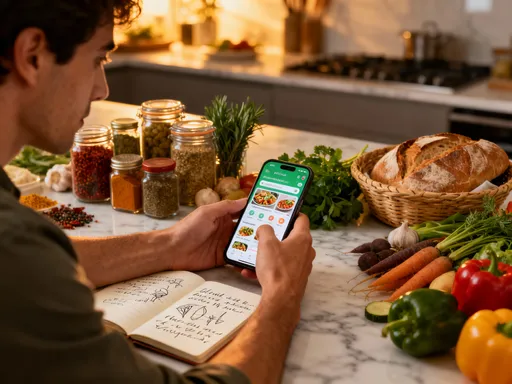
Here’s the truth: I wasn’t looking for a solution for my dad. I was trying to get healthier myself. I’d been walking more, drinking more water, trying to sleep better—just the usual midlife reset stuff. And I downloaded this simple health app to keep myself honest. Nothing fancy. No flashing charts or complicated dashboards. Just a clean interface where I could log my steps, how much water I drank, and even how I was feeling each day with a quick emoji—😊, 😐, or 😔. It felt kind of silly at first, like I was keeping a digital diary no one would read.
But then, one evening, I was scrolling through it and thought, What if Dad used something like this? Not to fix anything. Not because he was sick. But just… to let me know he was moving, breathing, living. I knew he’d never use something complicated. He still calls the Wi-Fi “the wireless radio,” bless him. So I looked for something super simple—something that didn’t require a manual. And I found it: a family-friendly health app designed for light tracking and gentle sharing. No medical jargon. No pressure. Just a shared space where we could see each other’s little daily moments.
I called him the next day. “Dad, there’s this little app. You don’t have to do much—just tap a few buttons. I thought maybe we could both use it, just to stay a bit more connected.” Silence. Then, “Oh, I don’t know. I’m not very tech-savvy.” I didn’t push. Instead, I said, “How about I come over this weekend, and I’ll show you? Five minutes, I promise.” He agreed, mostly, I think, to get me off the phone.
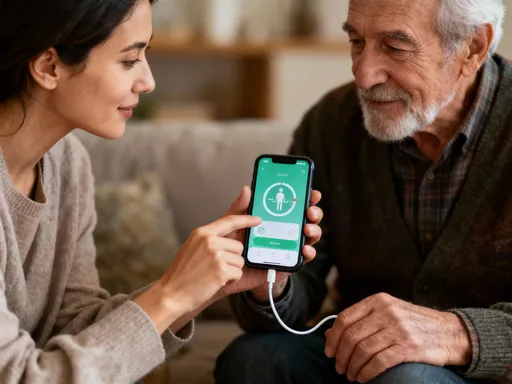
When I visited, I pulled out my phone, opened the app, and walked him through it—just steps, water, sleep, and mood. I showed him how to tap the little shoe icon when he walked, how to mark a glass when he drank tea. “And see this smiley face? If you’re feeling good, tap the happy one. If you’re tired, the sleepy one. No right or wrong.” He nodded slowly. “So it’s like… leaving a note?” I smiled. “Exactly. Like leaving me a little note every day.” That clicked for him. The next morning, he texted me a screenshot: “First walk done. 2,000 steps!” I nearly cried. It wasn’t the number. It was the fact that he’d thought of me. He’d reached across the distance, not with words, but with a tap on a screen.
Small Data, Big Feelings
Here’s what surprised me: the app didn’t feel cold or clinical. It felt warm. Human. Because it wasn’t about the data—it was about the story behind it. When I saw his step count was 7,500 one Tuesday, I didn’t just think, “Great, he walked.” I thought, He must’ve gone to the park. Maybe he saw the ducks. Maybe he sat on his favorite bench. And I’d text: “Nice walk! Did you see any birds today?” He’d reply, “Three geese. One tried to steal my sandwich.” Suddenly, we weren’t just sharing numbers—we were sharing moments.
And when his steps dropped to 1,200? I didn’t panic. I called and said, “Rough day?” He sighed. “Hip’s been stiff. Didn’t feel like moving.” That conversation never would’ve happened before. I wouldn’t have known to ask. He wouldn’t have volunteered it. But the app gave us a gentle opening. No guilt. No pressure. Just care. And slowly, he started sharing more. He’d send a screenshot of his water log: “Drank six cups today!” I’d cheer, “That’s my dad!” He began leaving little voice notes in the app: “Just finished my walk. Sun was out. Felt good.” Hearing his voice, calm and steady, was more comforting than any text.
One morning, I opened the app and saw he’d logged 😔 for his mood. My heart sank. I called right away, softly: “Hey, everything okay?” He was quiet for a moment. Then, “Just woke up feeling a bit low. Not sure why.” We talked for 20 minutes—about the weather, about his garden, about nothing and everything. By the end, he said, “You know, I feel better already.” That’s when I realized: the app wasn’t just tracking health. It was creating space for emotional honesty. It gave him a safe, low-pressure way to say, “I’m not quite okay,” without having to carry the weight of a heavy conversation. And it gave me the chance to be there—even when I wasn’t there.
Making It Work for Real Life
Now, I know what you might be thinking: “My mom would never use an app.” Or, “My dad would hate being ‘watched.’” And you’re not wrong. Technology only works if it fits your family’s rhythm. It can’t feel like homework. It can’t feel like surveillance. So here’s what we did to make it feel natural, not forced.
First, we started small. Just one habit—his morning walk. That was it. No pressure to log water, sleep, or mood. Just steps. Once that felt normal, he added tea—because he drinks three cups a day, and he liked marking them off. “It’s satisfying,” he said. “Like crossing things off a list.” We didn’t aim for perfection. Some days, he forgot. Some days, I didn’t check in. That’s okay. The goal wasn’t to track every detail—it was to stay connected.
Second, we used voice notes instead of typing. He found typing hard on the small screen. But speaking? That was easy. So he’d tap the mic and say, “Walked to the post office. Mail came early.” Or, “Didn’t feel like cooking. Had soup.” I did the same—“Just dropped the kids at soccer. Traffic was awful!” It made the app feel more like a conversation and less like a report.
Third, we used gentle reminders—not deadlines. The app lets you set a soft notification: “Time for your walk?” not “You haven’t walked in 24 hours—FAILURE.” Big difference. It’s the tone that matters. We wanted encouragement, not guilt. And over time, those little nudges became part of his routine, like a friendly nudge from a neighbor.
The key? We never treated it like a test. We treated it like a shared habit—like watering a plant together, even if we lived in different houses. It wasn’t about numbers. It was about showing up.
When Tech Supports, Not Replaces, Human Care
I’ll be honest—I was worried at first that this app would make us talk less. That we’d just check the dashboard and assume we knew how each other was doing. But the opposite happened. We started calling more. Because now, we had things to talk about. “I saw you walked 8,000 steps—where’d you go?” “You logged three moods this week—rough patch?” It gave us conversation starters. It broke the ice.
And it helped me care in a smarter way. Instead of asking, “Are you okay?”—a question he’d always answer with “fine”—I could say, “I noticed you haven’t been walking much. Want me to come over this weekend?” That’s specific. That’s kind. That’s care in action. The app didn’t replace our relationship. It deepened it. It gave us a shared language for care—one that didn’t rely on big speeches or emotional confrontations.
And for him? It made him feel seen. Not watched. Seen. He told me, “It’s nice knowing you’re looking out for me, even when you’re busy.” That hit me right in the heart. Because isn’t that what we all want? To know someone is paying attention? To know we matter, even in the small moments?
This isn’t about replacing hugs with apps. It’s about using a simple tool to make those hugs mean more when they finally happen. It’s about filling the space between visits with tiny moments of connection—so the distance doesn’t grow so wide.
Beyond Health: Building a Shared Digital Ritual
What started as step counting turned into something much bigger. It became our ritual. Our little digital dance. We began sharing photos—him standing by his tulips in spring, me at my daughter’s school play. We’d leave voice messages: “Happy Tuesday!” or “Thinking of you.” We even started cheering each other on. When I was stressed about work, he sent a voice note: “Take a walk. Breathe. You’ve got this.” When his knee acted up, I sent a photo of a stretching routine I found—“Try this, Dad. Gentle on the joints.”
The app became a living scrapbook of care. Not just of health, but of life. It held our laughter, our struggles, our quiet victories. And over time, I realized—we weren’t just tracking steps. We were building a shared story. One tap, one voice note, one emoji at a time.
And here’s the beautiful part: it didn’t feel like technology. It felt like love, just wearing a different coat. We weren’t “using an app.” We were staying close. We were parenting each other in our own way—me looking out for his health, him looking out for my peace of mind. It became a two-way street of care.
Why This Matters More Than Ever
We live in a world where families are scattered. Where work, life, and distance pull us apart. And yet, we still crave connection. We still want to know our people are okay. We still want to say, “I’m here,” even when we can’t be there.
This experience changed how I see technology. I used to think of apps as distractions—things that pulled us away from real life. But this one? It pulled us into real life. It didn’t replace our calls. It made them richer. It didn’t replace our visits. It made them more meaningful. It gave us a way to live alongside each other, even when we were miles apart.
So if you’ve ever looked at your phone and wondered, “Should I call Mom?” or “Is Dad really okay?”—I want you to know there’s another way. You don’t need a complicated system. You don’t need medical devices or daily reports. Just a simple app. A shared habit. A little courage to say, “Let’s try this together.”
Because connection isn’t always loud. Sometimes, it’s a tap on a screen. A green checkmark. A smiley face. A voice note that says, “Just walked to the store. All’s well.”
Those tiny digital handshakes? They’re not small at all. They’re quiet acts of love. They say, “I’m thinking of you.” “I care.” “You’re not alone.”
And in a world that often feels too fast, too busy, too disconnected—those little moments might be exactly what holds us together.